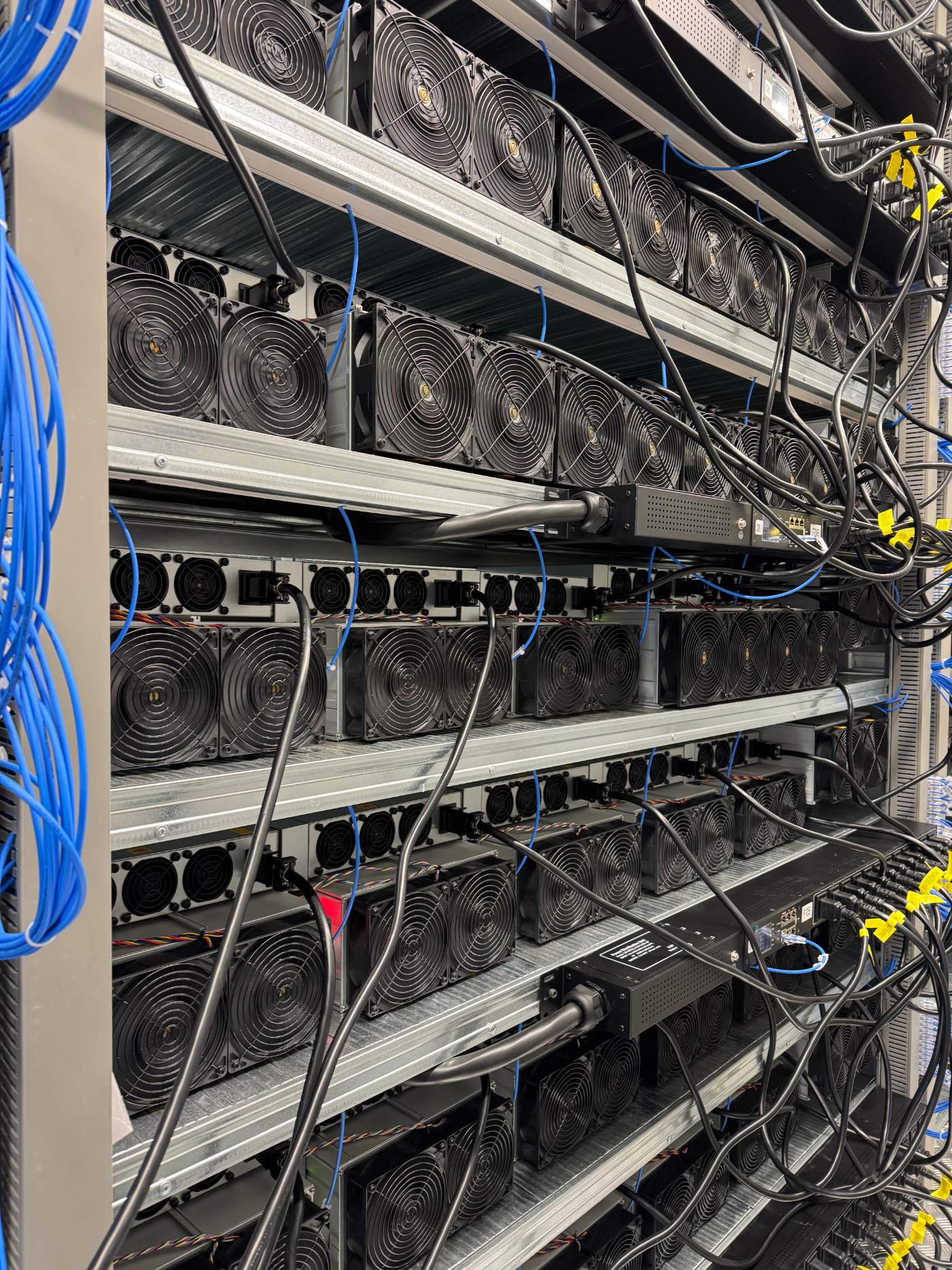
Fixed, indexed and capped: the three shapes a hosting customer meets in practice, what each one costs and which risk it removes.
A hosting quote that says "fixed" and one that says "indexed" are not two versions of the same offer with different marketing behind them. They are two different allocations of the same underlying risk, and a customer who does not know which one they are looking at is agreeing to carry a risk without knowing it. Underneath every hosting rate sits a decision about who absorbs the movement in the underlying power price, and that decision comes in a small number of recognisable shapes.
Fixed, indexed and capped, what each one is
A fixed rate quotes one number per kilowatt hour for the life of the term, regardless of what the underlying power price does in the meantime. The customer pays the same figure whether the market moves up or down, and the number does not need recalculating month to month.
An indexed rate ties the customer's price to a published reference or to the operator's own underlying cost, adjusted on an agreed schedule. When the underlying price moves, the customer's rate moves with it, in both directions, and the contract typically states how often the adjustment happens and against what reference it is measured.
A capped rate is a hybrid: the customer's rate tracks an index as it moves, but only up to an agreed ceiling. Above that ceiling the customer stops paying more even though the underlying price keeps rising, while below the cap the rate still moves normally in both directions. It behaves like an indexed rate for most of its range and like a fixed rate at the extreme.
The pattern indexed and capped rates are built to track (the shape a power price traces across a day and across a year) is covered separately in seasonal and daily price shape, and the two pieces are best read together.
Who carries the risk in each shape
Every one of these structures moves the same underlying risk somewhere; none of them makes it disappear. Under a fixed rate, the operator carries the risk that the underlying price rises above the fixed figure, and prices the offer accordingly. Under an indexed rate, the customer carries that same risk directly, in exchange for a rate that typically tracks the underlying market more closely across the full term. Under a capped rate the risk is split: the customer carries the movement below the cap, and the operator carries whatever happens above it.
This is not a judgement on which allocation suits a given fleet. A fixed rate that suits an operation planning against a tight, fixed budget can be the wrong shape for one that is comfortable with variability in exchange for typically closer tracking of the market, and a capped rate suits a customer who wants protection against the extreme without paying for certainty across the whole range. What matters is knowing which risk you are holding, not which structure sounds safest written down on the page.
What certainty costs, and what term length does to it
Removing a risk from the customer's side of the ledger does not make the risk disappear, it moves it onto the operator's book, and an operator carrying that risk prices it into the rate offered. That is the mechanism behind why a fixed or capped rate typically carries a premium over an equivalent indexed rate: the premium is the price of someone else holding the variability instead of you.
Term length interacts with that premium directly. A longer commitment gives an operator more room to manage the risk it is taking on, through its own supply arrangements and through the certainty a longer relationship provides, and that can be reflected in the price offered for a fixed or capped structure. A shorter term gives the customer more flexibility to walk away or renegotiate, but typically at a less favourable price for the certainty being asked for. Neither trade-off is free, and the way to read an offer is to ask what specific term is attached to the number quoted, since the same word (fixed, capped or indexed) can describe very different offers depending on how long it runs for.
What an operator asks for in return
An operator taking on price risk on a customer's behalf is not doing so for free, and it typically wants something back beyond the rate itself: a longer minimum term, a deposit or prepayment against the contract, or a take-or-pay commitment that guarantees the volume the pricing was built around. Ask what security is being requested alongside a fixed or capped rate, and treat that security as part of the price rather than as a separate condition attached to it. A quote that looks favourable on the rate line and asks for meaningful security elsewhere is not automatically a worse offer, but it is not simply a cheaper one either. The full cost of a shape includes what is being asked for in return, not only the number per kilowatt hour.
Questions that reveal the shape of an offer
The right shape depends on a fleet's own tolerance for variability and the term it is genuinely willing to commit to, and that is a judgement only the fleet owner can make with full visibility into their own numbers. What a hosting customer can do before signing is put the same set of questions to any offer on the table.
- Is the rate fixed, indexed or capped, and if indexed or capped, against what reference and on what adjustment schedule?
- What term is the quoted number attached to, and what happens to the rate if that term changes?
- What security, deposit or minimum commitment is being asked for in exchange for the certainty on offer?
- If capped, what does the rate do below the cap in normal conditions, not only where the ceiling itself sits?
We go through the components that sit inside a hosting rate (energy, transmission and distribution, taxes and levies, operations and margin), and which of them move with an index and which do not, in how a hosting rate is built, and our hosting rate page shows how the same components sit inside a rate per kilowatt hour and how to request a written quote.