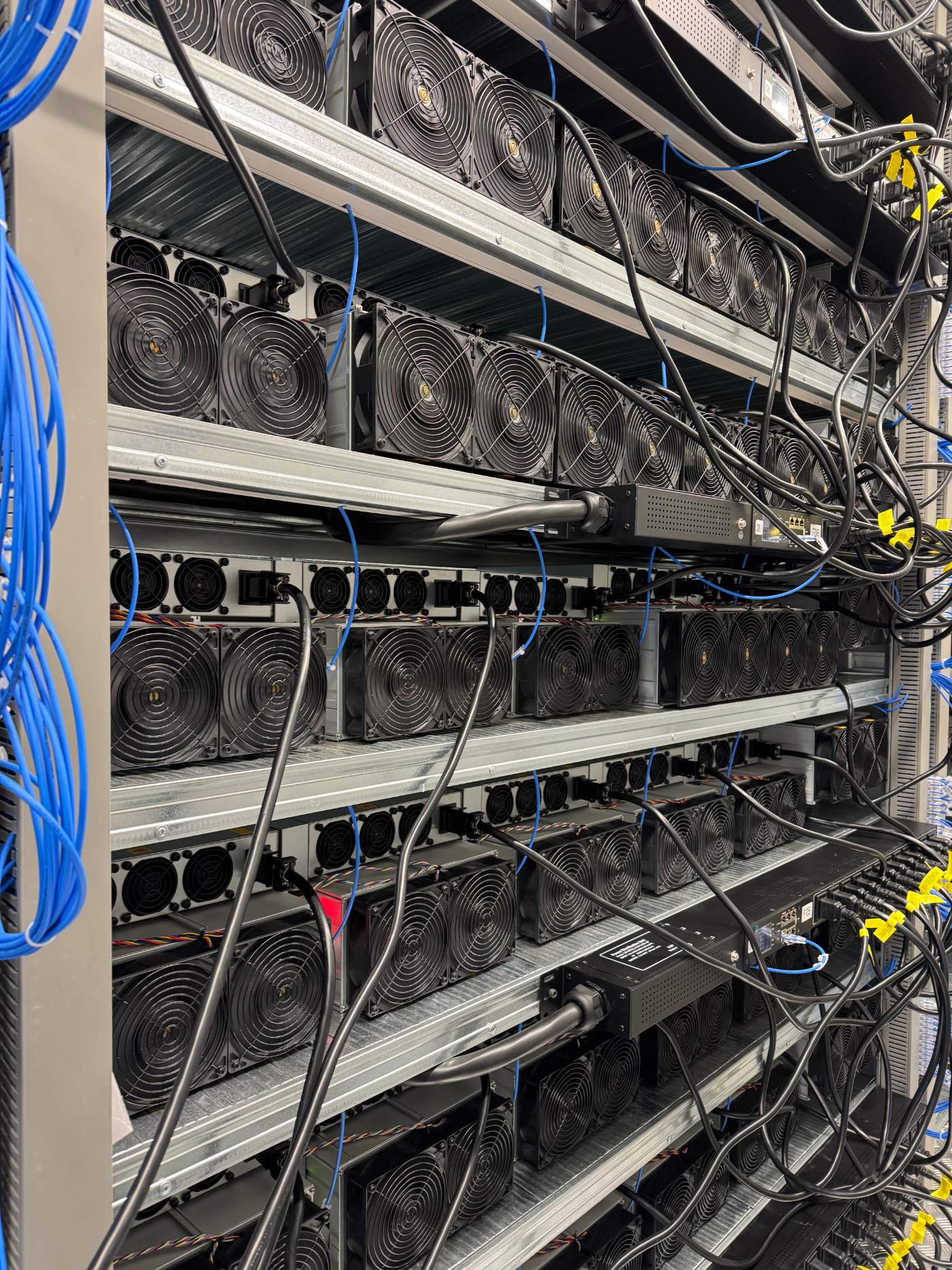
Density, redundancy, connectivity and contract length compared, so a site owner can see which of the two workloads a location can serve.
A site that hosts ASICs well is not automatically a site that can host AI accelerators well, and the gap between the two is bigger than most owners expect when a broker first raises the idea. Both workloads want power and space, which is why the comparison looks simple from a distance. Underneath that, the two draw on the site's electrical, cooling, network and contract structure in different ways, and a location that excels at one can be genuinely unsuited to the other without any part of the site being poorly built.
Density and what it demands of power and cooling
ASIC hosting draws power in a flat, even pattern across the floor. Rack after rack pulls roughly the same load, and the airflow design that suits one position suits its neighbour as well. That evenness is a large part of why straightforward, high-volume air cooling has been sufficient for most of the industry's history: the thermal problem is uniform, so the cooling solution can be uniform too. Miners also keep working across a broad range of inlet temperatures, so the tolerance band the cooling has to hold is wide.
AI accelerator racks do not draw power evenly, and a rack running current-generation accelerators at sustained utilisation asks for far more heat removal from that single position than an ASIC hosting site's airflow design was ever built to handle, with a narrower tolerance for thermal excursions than most ASIC deployments have had to plan for. That usually pushes the cooling approach towards liquid, whether direct-to-chip, rear-door heat exchangers or immersion, each of which is a different physical build from a hot-aisle arrangement optimised for air. A site can be designed to carry both, but only if the liquid cooling infrastructure (piping, coolant distribution and containment) is planned in from the start. Retrofitting it onto a hall built for air is a materially different project than extending an existing air-cooled layout, and the cost of that retrofit tends to land on whichever workload arrives second.
The same unevenness reaches the electrical design before it reaches the cooling. Both workloads want megawatts delivered reliably at a defined voltage, and both are exposed to the gap between announced and energised capacity. Where they split is distribution across the floor: a single high-density accelerator rack can draw several times what its neighbour does, and the distribution boards, busway and breaker sizing have to be engineered for that peak, not for an average across the room. A site designed for an even ASIC load does not automatically have the headroom or the electrical topology for a small number of very hungry racks, which is why the useful question is not the total capacity but the maximum kW that can be delivered to a single rack position, and what has to change to get there.
Redundancy, and what it costs to build in
ASIC hosting has historically tolerated single points of failure that AI hosting cannot. A miner that trips offline for an hour loses an hour of hashrate, which is a real cost but a recoverable one. A training job interrupted mid-run can lose considerably more than an hour's progress if the checkpoint cadence does not line up with the outage, and inference workloads serving live traffic carry their own uptime expectations that look closer to a conventional data centre SLA than to mining hosting.
That difference in tolerance shows up directly in what redundancy costs to build. N+1 or 2N electrical topology, UPS coverage sized for the full load, and generator backup are line items an ASIC-focused site could historically scale back without much practical consequence. A site pursuing AI tenants usually cannot. Before assuming a facility can serve both, ask which redundancy tier applies to which workload on the same floor, and whether the capital cost of that redundancy is being carried by the tenant who needs it or spread across both.
Connectivity and latency
Mining is close to silent on the network. A pool connection and basic telemetry account for most of the traffic a container generates in a day, and a site can run a large ASIC hosting operation on a connection that would barely register against what an AI tenant expects as a baseline. Distributed training and inference serving both need substantial fibre connectivity, and often specific latency and redundancy requirements to carriers or cloud interconnects that a mining-first site was never built to provide.
This is frequently the single largest gap between the two use cases, and it is not one that spare power capacity closes on its own. Fibre routes, carrier relationships and, in some cases, direct interconnects take real lead time to put in place, independent of how much electrical capacity the site already has. Ask what fibre terminates at the building today, who the carriers are, and what the current latency looks like to the interconnect points an AI tenant would need, rather than what is planned for a future phase.
Contract length, capital and interruptibility
The commercial shape of the two workloads diverges as much as the physical one. Mining hosting agreements are frequently built around interruptibility: many are priced so the operator can curtail the load in exchange for a lower rate, and the fleet owner accepts that trade because a few curtailed hours are recoverable. AI compute contracts tend to run the other way. A tenant running a training job or serving live inference generally needs firm, non-curtailable power, and is willing to commit to a longer minimum term in exchange, because their own commitments to their customers run long as well. That longer term also tends to come with a larger capital commitment on the tenant's side, whether that is their own hardware investment or a build-out they are funding on the site.
A location that wants to serve both workloads has to be able to segregate these commitments clearly, electrically and contractually, so curtailing the mining load is never used to protect an AI tenant's uptime at the miner's expense, or the other way round. If you are looking at a site that already hosts, or plans to host, both, ask directly how curtailment rights are structured when the two sit behind the same substation, and get the answer in the agreement rather than as a verbal assurance.
What to check before assuming a site can serve both
A site that markets itself as suited to both ASIC hosting and AI compute is not wrong to do so, but the claim should be tested against specifics rather than accepted on the label. What is the maximum deliverable kW to a single rack position, and does the current cooling infrastructure support that density, or would it need to be built, and at whose cost? What redundancy tier applies to each workload, stated separately rather than as one figure for the whole site? What fibre terminates at the building right now, and to which interconnect points? And how are curtailment and interruptibility terms written for each workload where they share electrical infrastructure? A site that can answer all four with specifics, in writing, is one worth taking seriously for a mixed deployment. Answers in generalities are an answer of their own.
Not every site needs to do both, and a location built and priced well for one workload is not a weaker facility for lacking the infrastructure the other requires. What matters is knowing which one a given site is built for before signing on the basis of what it could theoretically support. That is why our partnerships start from the requirement: what is in place and what would need to be built is named, and the split of responsibilities is written down before anything is built. For AI compute, we provide the land, the power and the infrastructure, and the partner brings and operates the hardware. Our AI partnerships page sets out the three structures this can take: colocation, powered land and a joint venture.