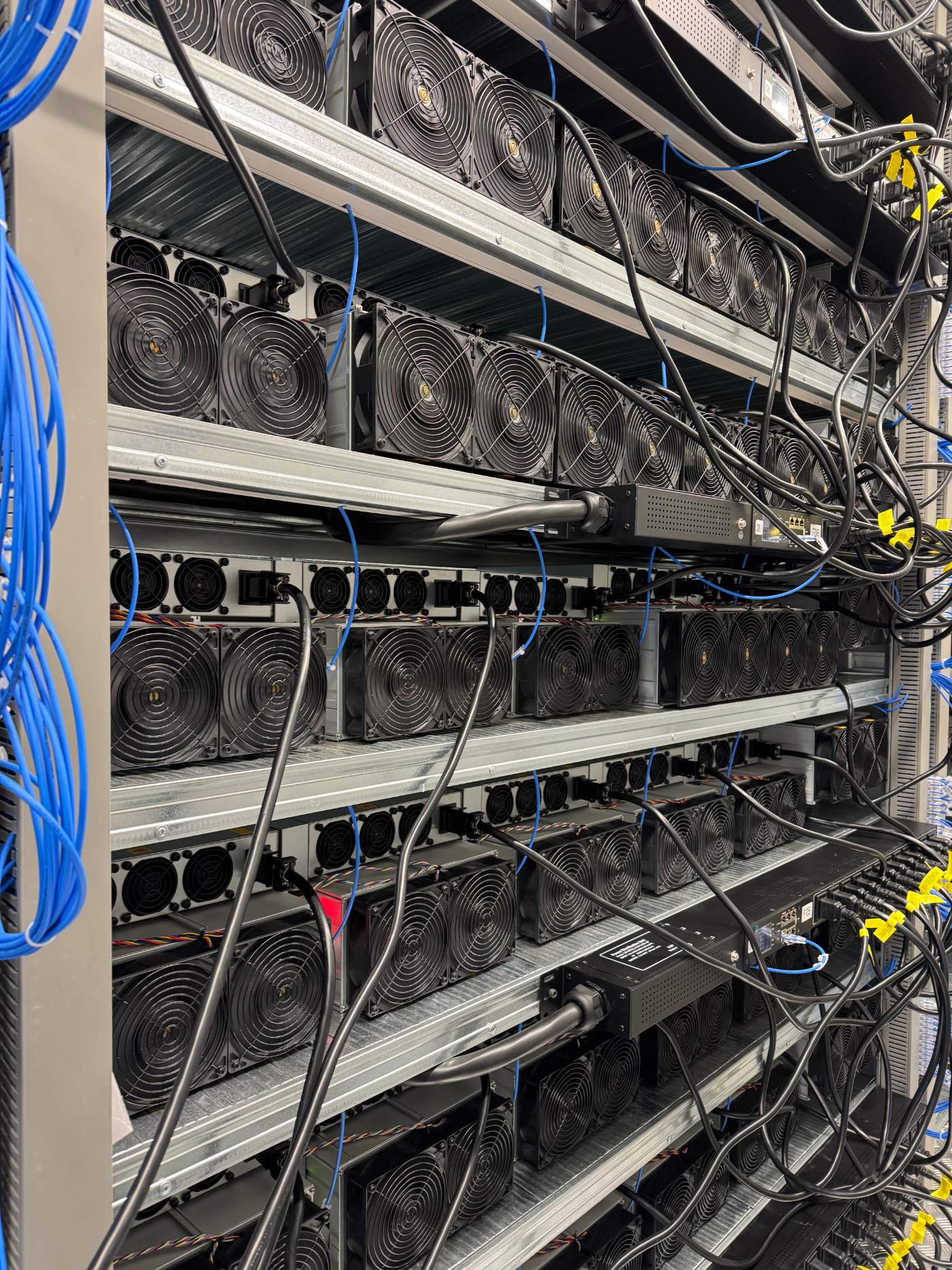
The signals visible from the operations side of a fleet, and what a buyer can reasonably ask a seller to prove before the money moves.
A used machine can look clean, in original packaging, powered up for a demonstration, and still carry a history the case gives no sign of. What shows a unit's condition is how it behaved while it was running: temperatures on its own hashboards over time, how often it needed a restart, and whether its output held steady or drifted before it changed hands. A buyer without access to that record is buying on trust rather than evidence, which is a different transaction than it looks like at first glance. A seller who has hosted the fleet has that record sitting in a monitoring system already. A seller who has run it themselves, in a garage or a small self-managed rack, may simply never have kept it.
What day-to-day operation reveals
An operator watching a fleet day to day sees things a one-off inspection cannot. A board that consistently runs warmer than its neighbours on the same intake air points at its own thermal path, even if nothing else about it looks wrong. A unit that needs an unusual number of manual restarts points at its power stage or its firmware, even between failures that would otherwise count as none. Hashrate that drifts down gradually rather than holding flat is a different signal again, one that a single reading at one point in time will never catch, because a snapshot only shows where a value sits, not which direction it has been moving. These are not failures in the sense of a machine going offline, but each is the kind of pattern that shows up in continuous monitoring and nowhere else, which is the case our piece on failure statistics and baselines makes for tracking a fleet's own numbers rather than trusting a single figure.
The same logic applies at the level of one machine as it does at the level of a fleet. A single unit's own history, read on its own, tells you what that unit has been through. Compared against how its batch mates behaved over the same period, it also tells you whether what happened to it was ordinary for that delivery or unusual within it, which is a distinction a buyer looking at one machine in isolation has no way to draw.
Why identical units age differently
Two machines from the same batch, run in different conditions, do not age at the same rate, and that gap widens the longer they run. A unit positioned in a warmer part of an airflow path, or one that has spent more of its life running near the top of its thermal range, carries more accumulated stress than an identical unit that has not, regardless of what the calendar says about its age. Duty cycle matters as much as age in months: a machine run continuously without interruption has a different history than one that has been powered down and restarted repeatedly, and the two are not directly comparable on hours alone. It does not show up by looking at a unit. It shows up in the record of where it ran, under what conditions, and for how long, which is exactly the kind of detail a private sale rarely comes with and a hosted fleet's own operator usually has.
That is no reason to assume the worst about a used unit. A machine that has spent its working life in a well-run, well-monitored site, in a favourable position within the airflow, can be in better condition than a younger unit that has had a harder run somewhere else. The point is that age in months is not the measure that matters. The record of where and how a unit ran is.
Repair history, read correctly
A repaired unit is not automatically a worse unit, but a repair record is only useful if you can read what it says. A single board swap early in a machine's life, resolving a manufacturing defect that showed up quickly, is a different story than a pattern of repeated repairs to the same subsystem later on, which tends to point at an underlying cause rather than a one-off event. Ask what was repaired, when, and why, not just whether the unit has ever been serviced, because a repair with no explanation attached tells you almost nothing you can act on. A seller who can produce that detail is showing you how the machine was tracked as much as what was repaired.
Firmware and tuning history deserve the same question. A unit that has been run at a setting outside what the manufacturer intended, for part or all of its life, has a different stress history than one that has not, even if nothing about that shows up in a repair log. Ask whether the firmware and any tuning settings are known and whether they have changed, since that is a form of history that leaves no physical trace but still shapes what the unit has been through.
What to check before and after the handover
Before money moves, a buyer can reasonably ask for a specific set of records rather than a general assurance that a unit is "clean":
- Runtime logs covering temperature, restarts and hashrate over a meaningful stretch of time, not a single snapshot.
- A record of where the unit sat physically and under what conditions, if it was part of a hosted fleet.
- Any repair history, with what was replaced, when, and the reason given at the time.
- Confirmation of the unit's batch and original delivery date, where it is known.
After the handover, the same checks apply in reverse. Run the unit under normal load for a period before treating it as accepted, watch the same signals (temperature, restart frequency, hashrate stability) and compare what you see against whatever record came with it. A gap between what was represented and what the machine does under your own monitoring should be raised immediately, while the details of the sale are still fresh, rather than months later when the two sides disagree about when a problem started.
This is close to what a hosting operator already does with every machine that arrives, whether it was bought new or used. Our hardware intake process covers how units are counted, inspected and logged by serial number from the point they arrive on site, and running a used purchase through the same process before it joins a working fleet is a reasonable way to turn a seller's claims into your own record, rather than taking them on trust. Our hardware page covers the machines we host, from any manufacturer and any source.